Unlocking the Music Within: Practicing with Purpose
Unlocking Your Musical Potential
As musicians, and specifically as clarinettists, the path to discovering the music within us begins with practice. So, go practice! But first, let’s talk about the benefits of practicing with purpose.
Practice with purpose
Practice is more than time spent with the instrument. It’s how we listen, how we organise our thinking, and how we respond to what we hear.
At different points in my own playing and teaching, I’ve noticed that many practice sessions fall into one of two traps: either we play without direction, or we become so task-driven that we stop really listening. Purposeful practice sits somewhere in between. It gives us enough structure to stay focused, while leaving room for curiosity, reflection, and musical discovery.
Before worrying about how long you practise, it’s worth pausing to consider how you practise — and why.
Starting with intention
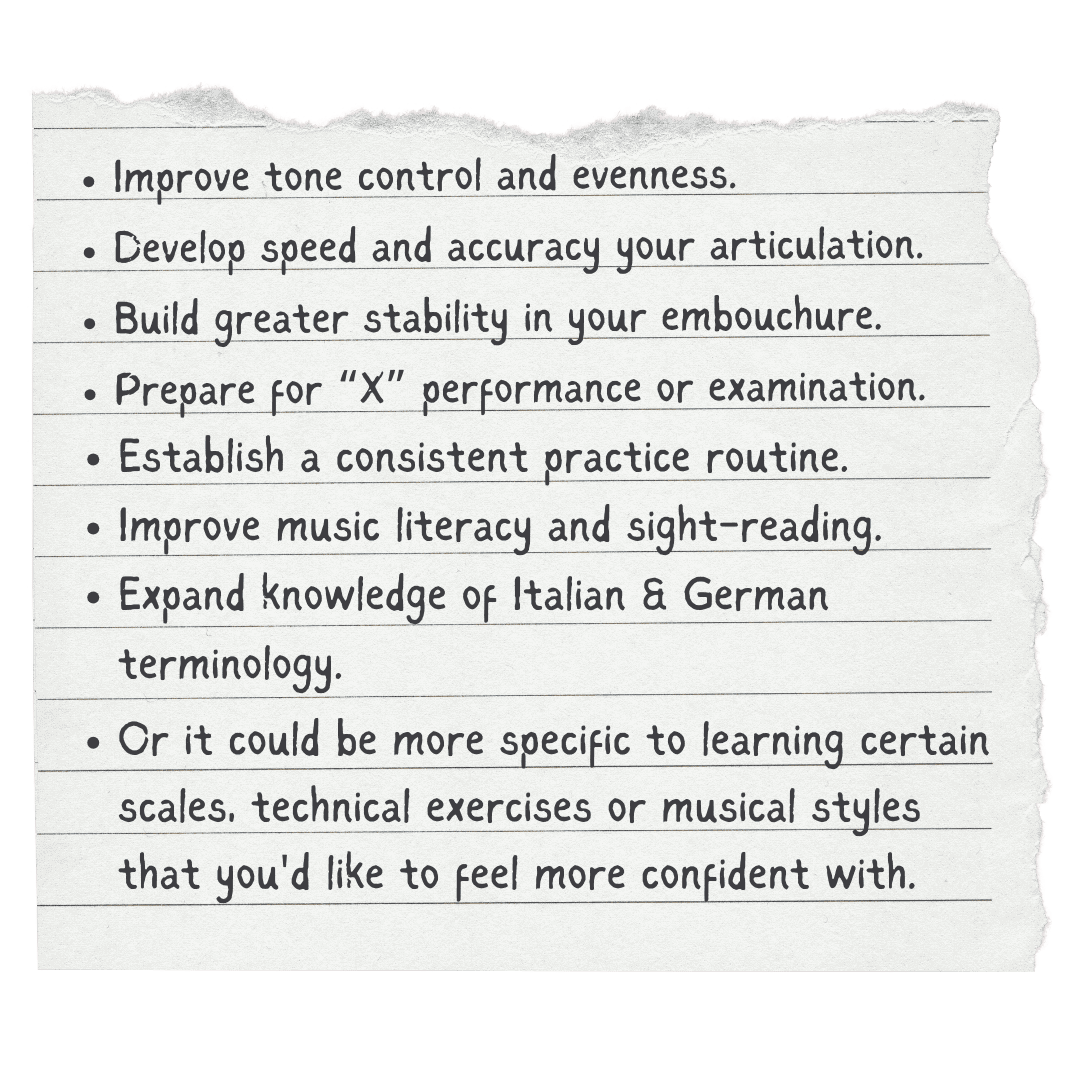
Purposeful practice begins with crafting a thoughtful plan. It helps to identify what you need to work on and to break each challenge down into small, achievable tasks. This doesn’t need to be complicated or rigid. In fact, the simpler the plan, the easier it is to stay present while playing.
There are many tools that can help you map this out clearly and track your progress over time. One that I often use with my students is My Clarinet Companion. Not because it prescribes a single way of practising, but because it encourages reflection — noticing what’s improving, what’s feeling unsettled, and what might need more time.
This plan will look different for everyone. Take a moment now to jot down your current goals, or the aspects of your playing you’d like to improve. Even a few short notes can bring surprising clarity.
Organising the session
In my own practice, I like to loosely organise sessions around four key areas:
Tone
Articulation
Finger fluency
Repertoire
This isn’t a formula, and it certainly isn’t the only approach. Rather, it’s a way of ensuring that each session touches on both fundamentals and music-making. On some days, one area might need more attention than another — and that’s perfectly fine.
What matters is noticing patterns over time. Which areas do you naturally gravitate toward? Which tend to be avoided? Awareness alone often points us toward what needs care.
Listening as an active skill
One of the most important elements of purposeful practice is learning how to listen — not just to whether notes are right or wrong, but to how they sound and how they feel.
It can be useful to ask yourself:
Does the sound remain consistent as I move through registers?
Where does the instrument feel easiest to play, and where does it feel resistant?
Am I reacting to what I hear, or simply moving on?
These kinds of questions slow the process down in a productive way. They help shift practice from repetition to awareness.
Quality over quantity
It’s easy to equate progress with hours logged, but meaningful improvement often comes from shorter, more focused sessions. Ten minutes of attentive practice can be more valuable than an hour of unfocused playing.
If you find yourself repeating something without improvement, it may be a sign to pause, simplify, or listen more closely — rather than push harder. Purposeful practice is not about forcing results, but about creating the conditions for progress to happen.
Reflection and continuity
Finally, purposeful practice benefits from reflection. Writing down what worked, what didn’t, and what felt different can help turn individual sessions into a connected journey rather than isolated events.
Over time, these small observations build a clearer picture of your playing — and of how you learn best. That understanding is far more valuable than any single exercise.
Practising with purpose doesn’t mean practising perfectly. It means practising with attention, curiosity, and patience — and allowing your approach to evolve as your playing does.