A neat way to develop control and clarity at the front of every note.
Ghost Tonguing is the natural continuation of the ideas explored in Distance Training. Once you’ve developed a clear awareness of where and how the tongue contacts the reed, this study takes the next step: learning to control the release of the tongue with precision, ease, and consistency.
By keeping the tongue in contact with the reed during the rest while maintaining airflow, you learn to shape both the beginning and end of each note. The goal isn’t speed, but control — allowing the sound to speak cleanly as the tongue releases, and maintaining a supported airstream as the tongue returns to the reed.
I’ve said it before, but I’ll say it again: articulation on the clarinet is challenging because it’s a technique we can’t see. Like Distance Training, this exercise is designed to deepen your physical awareness of how articulation should feel, guided by careful listening to how it sounds. Any instability, scoop, or accent at the front of the note becomes immediately audible, giving you clear feedback to adjust and refine.
The exercises focus primarily on the Clarion register, where tongue height, voicing, and air support are most exposed. I’ve included a final scale study that tests this awareness across the register, but feel free to explore other registers of the instrument using the same approach.
In a nutshell:
Refine articulation through controlled tongue approach and release
Develop clean staccato without percussive attack
Strengthen air-led articulation
Maintain clarity and stability across registers
Includes:
• Printable PDF
• Progressive ghost tonguing exercises
• Clear, concise performance guidance
• Designed to follow Distance Training
• Suitable for intermediate to advanced clarinettists
A neat way to develop control and clarity at the front of every note.
Ghost Tonguing is the natural continuation of the ideas explored in Distance Training. Once you’ve developed a clear awareness of where and how the tongue contacts the reed, this study takes the next step: learning to control the release of the tongue with precision, ease, and consistency.
By keeping the tongue in contact with the reed during the rest while maintaining airflow, you learn to shape both the beginning and end of each note. The goal isn’t speed, but control — allowing the sound to speak cleanly as the tongue releases, and maintaining a supported airstream as the tongue returns to the reed.
I’ve said it before, but I’ll say it again: articulation on the clarinet is challenging because it’s a technique we can’t see. Like Distance Training, this exercise is designed to deepen your physical awareness of how articulation should feel, guided by careful listening to how it sounds. Any instability, scoop, or accent at the front of the note becomes immediately audible, giving you clear feedback to adjust and refine.
The exercises focus primarily on the Clarion register, where tongue height, voicing, and air support are most exposed. I’ve included a final scale study that tests this awareness across the register, but feel free to explore other registers of the instrument using the same approach.
In a nutshell:
Refine articulation through controlled tongue approach and release
Develop clean staccato without percussive attack
Strengthen air-led articulation
Maintain clarity and stability across registers
Includes:
• Printable PDF
• Progressive ghost tonguing exercises
• Clear, concise performance guidance
• Designed to follow Distance Training
• Suitable for intermediate to advanced clarinettists
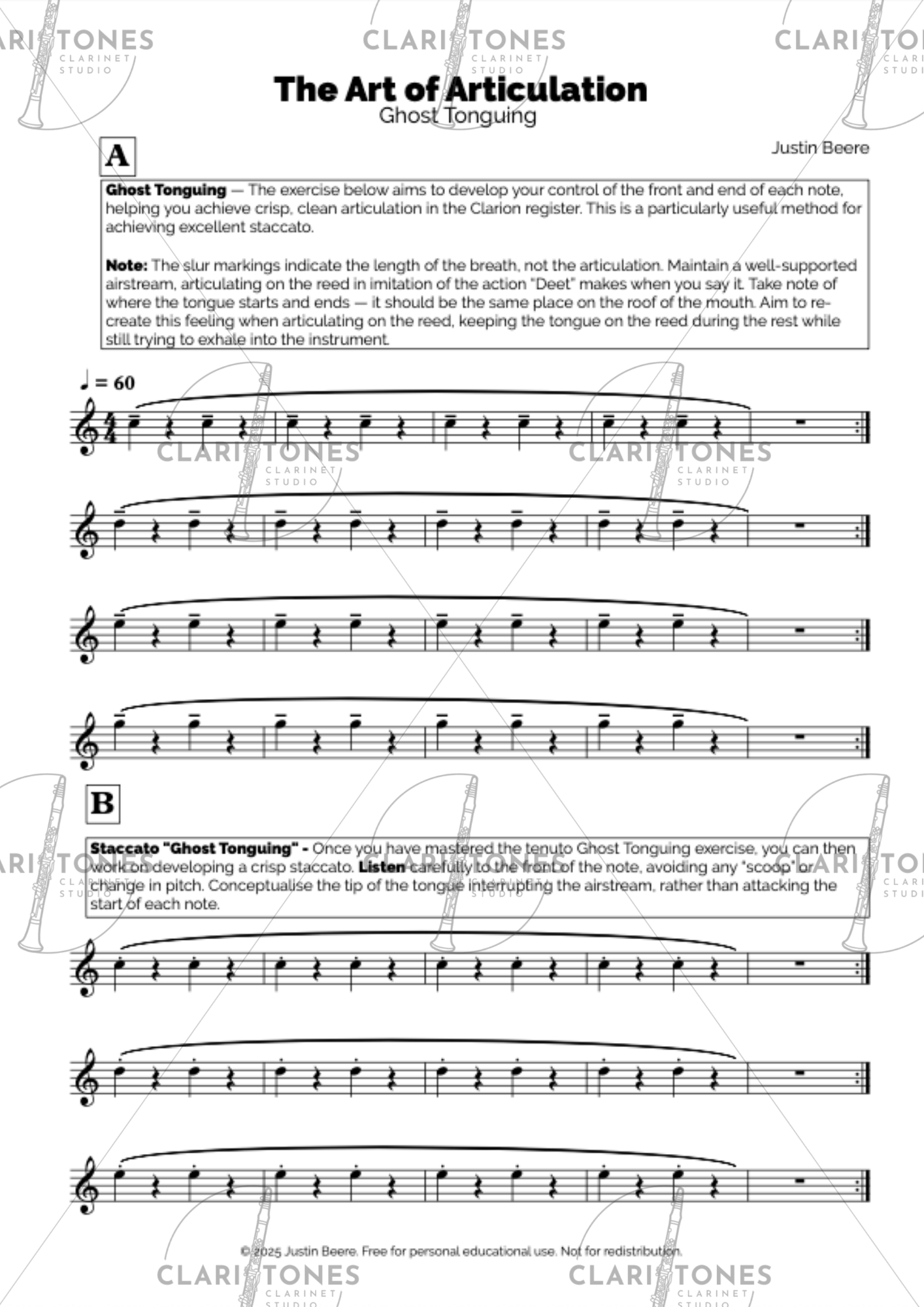 Image 1 of 1